Tait TP9400
The TP9400 is Tait's proven P25 portable with Phase 1 and Phase 2 capability, a compact 11.46 oz form factor, and AES encryption with Over-the-Air Rekeying. With analog sensitivity of -120dBm and LSM simulcast decode for P25 simulcast network compatibility, it is a mission-tested platform for agencies with established P25 infrastructure. Software-upgradable from 1,000 to 2,000 channels without hardware replacement.
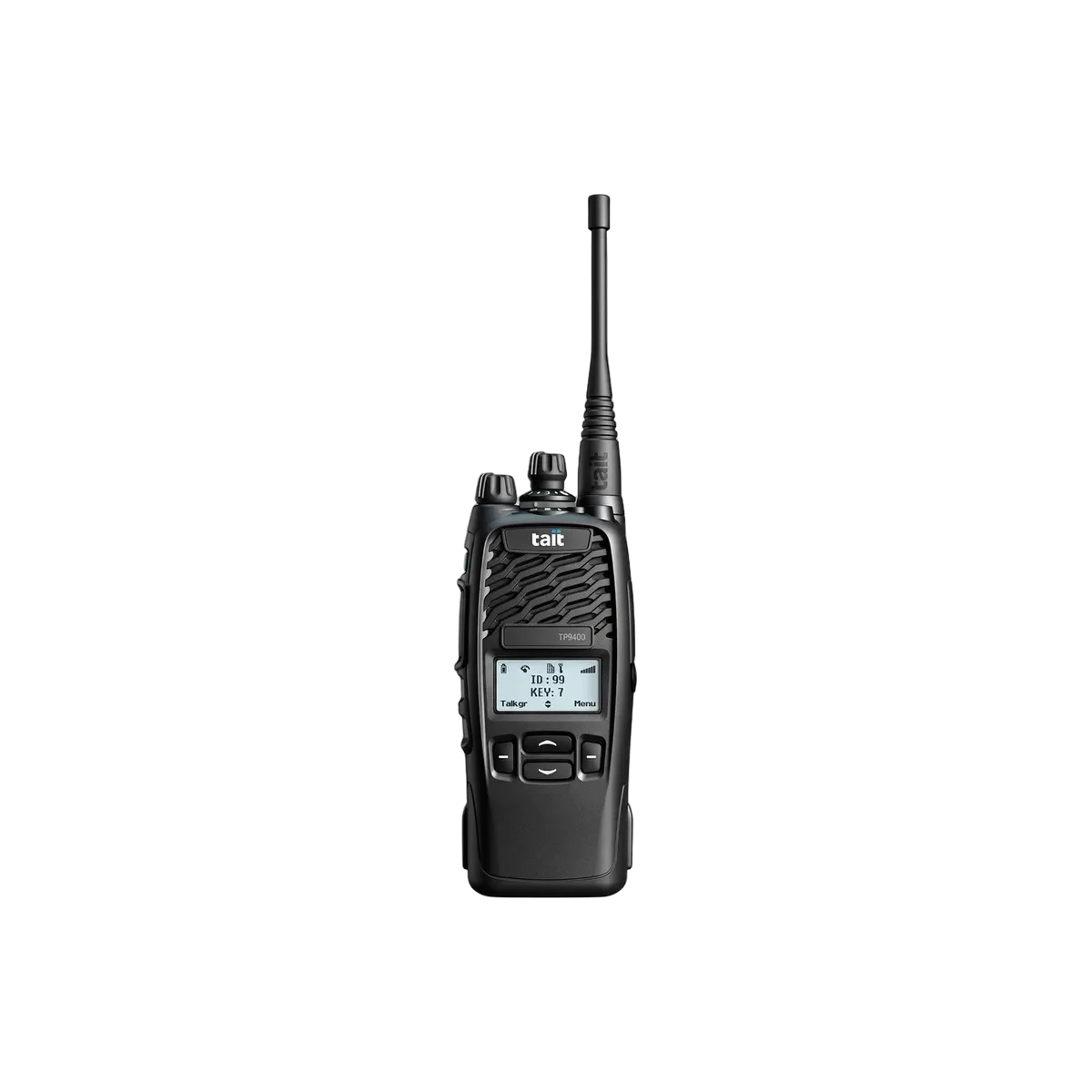
Overview
Agencies with established P25 Phase 1 or Phase 2 systems need a portable radio that handles every operational requirement of a mature trunked network: cryptographic key management, simulcast network compatibility, and the ability to remotely disable a lost or stolen radio from dispatch. These are not edge case features. They are day-to-day operational requirements for large public safety deployments.
The TP9400 covers VHF 136-174MHz, UHF 400-470MHz and 450-520MHz, and 700/800MHz 757-870MHz. Power output is configurable at VHF 5W, 3W, 2W, and 1W; UHF 4W, 2.5W, 2W, and 1W; and 700/800MHz 3W, 2.5W, 2W, and 1W. Analog sensitivity is 0.22uV (-120dBm) VHF/UHF and 0.22uV (-121dBm) at 700/800MHz. The TP9400 supports P25 Phase 1 FDMA, P25 Phase 2 TDMA, Analog Simulcast IP, and LSM (CQPSK) decode for P25 simulcast network compatibility. Standard channel capacity is 1,000 across 50 zones, software-upgradable to 2,000 channels and 100 zones.
AES encryption with OTAR (Over-the-Air Rekeying) allows cryptographic key distribution without physically touching each radio. Radio inhibit and uninhibit capability lets dispatch remotely deactivate a lost or stolen unit from the control system. IP65 and IP68 ratings, exceeds MIL-STD-810G, shock-absorbing corners, and a water-shedding grille provide the mechanical durability expected of a mission-critical P25 portable. Operating temperature range is -30 degrees C to 60 degrees C.
Key Features
OTAR Cryptographic Key Management
AES encryption with OTAR (Over-the-Air Rekeying) allows cryptographic key updates to be distributed to the entire fleet without requiring technicians to physically access each radio. This is a standard operational requirement for agencies that change encryption keys on a scheduled cycle for CJIS and DHS compliance.
Radio Inhibit and Uninhibit
Dispatch can remotely inhibit (deactivate) a lost or stolen TP9400 from the control system without physical access to the radio. When a radio is recovered, it can be uninhibited remotely. This reduces the security risk of a sensitive radio remaining active in the field after it is reported missing.
LSM Simulcast Decode
LSM (CQPSK) Linear Simulcast Modulation decode capability supports P25 simulcast networks where multiple base stations transmit simultaneously to eliminate coverage gaps. Many large county and state P25 systems rely on simulcast architecture, and LSM decode is required for reliable operation at the edges of simulcast zones.
P25 Phase 1 and Phase 2
Full P25 Phase 1 FDMA and Phase 2 TDMA trunking support means the TP9400 operates on both current and next-generation P25 systems. Analog Simulcast IP support adds backward compatibility with analog simulcast infrastructure still in use in many regional communication systems.
Software-Upgradable Channel Capacity
Base channel capacity of 1,000 channels across 50 zones is software-upgradable to 2,000 channels and 100 zones via a license, without replacing the radio hardware. This allows agencies to right-size the initial purchase and expand capacity as their network grows or operational requirements change.
Man Down and Emergency Features
Man Down, Lone Worker, clear voice, and programmable emergency key are standard. Integrated GPS supports Location Services for officer position reporting. Compact dimensions of 5.35 x 2.56 x 1.61 inches and 11.46 oz with the standard Li-Ion battery make the TP9400 comfortable for extended wear.
Interested in the Tait TP9400?
Our team can help you choose the right configuration for your operation. Call us or fill out the form.